25 million players. 53,000 courts. A single athlete who drew 500 million viewers to a Grand Slam final. And not one major tennis brand with a China-first commercial strategy.
I’ve spent years working in tennis across Asia. The gap between what China represents commercially and how the industry is actually treating it is the most striking disconnect I’ve seen in the sport.
The numbers are not subtle. China’s tennis market was worth $5.16 billion in 2024. It is projected to reach $8.77 billion by 2029 — an 11% annual growth rate at a time when most mature sports markets are growing at 2-3%. There are now 25 million tennis players in China, up 28% since 2021. The country hosted 98 international tournaments across 48 cities in 2024.
This is not an emerging market in the speculative sense. It is a market that has already arrived. The industry just hasn’t caught up with it.
The Zheng Qinwen Effect
No single factor has accelerated Chinese tennis faster than Zheng Qinwen.
When Zheng reached the US Open final in 2023, an estimated 500 million people watched in China. To put that in context: the entire US Open drew roughly 4 million viewers on ESPN. China’s audience for one match was larger than the ATP Tour’s entire global broadcast reach for most of the season.
Her Olympic gold medal at Paris 2024 compounded it. Tennis became a national story in China in a way it hadn’t been since Li Na’s Roland Garros title in 2011 — and the infrastructure that exists now dwarfs what was available then.
Zheng’s commercial portfolio reflects the scale of her profile. Dior, Rolex, Nike, Audi, McDonald’s, Gatorade, Lancôme, Beats, Tencent, Ant Group, Vivo — she earns an estimated $30 million annually from endorsements. That figure makes her one of the highest-earning female athletes in the world, and every brand in that list made a calculated bet on the size of her domestic audience.
What’s notable is who isn’t in that list: the ATP, the WTA at an institutional level, and any of the major equipment brands with a China-specific product strategy. The commercial infrastructure around Zheng is entirely brand-driven. The sport itself hasn’t organised around the opportunity she represents.
The Infrastructure Is Real
Sceptics of China’s tennis boom often point to participation numbers that are hard to verify independently. The court numbers tell a cleaner story.
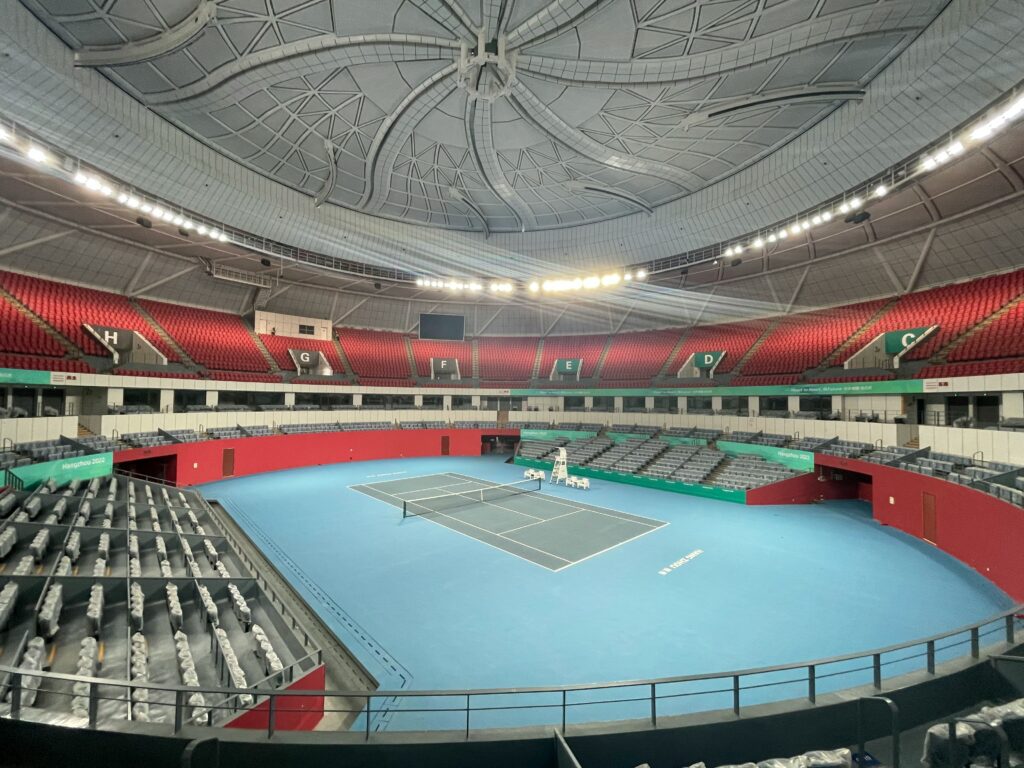
China had 53,805 tennis courts in 2024 — up from 49,767 in 2021. That 8% increase in three years represents tens of thousands of permanent facilities built into the country’s sporting infrastructure. These are not pop-up courts. They are the physical foundation of a long-term tennis ecosystem.
Tournament attendance supports the same conclusion. The Wuhan Open drew 180,000 spectators in 2024 — an 80% increase from its 2019 pre-pandemic numbers. The China Open reported $11 million in ticket sales, a 60% year-on-year increase. These are not vanity metrics from a market trying to attract investment. They are the results of an audience that is genuinely there.
The Commercial Gap
Here is the structural problem: tennis’s commercial model was designed around Western audiences and Western broadcasters. Sponsorship packages are priced and structured for European and American brands. Media rights deals are negotiated market by market, usually defaulting to domestic Chinese broadcasters whose coverage of the ATP and WTA is inconsistent. There is no unified China commercial strategy across either tour.
The brands that have figured this out are not tennis companies. Dior and Rolex saw Zheng before the sport did. Tencent has invested in tennis content distribution. Xiaohongshu — China’s answer to Instagram — has become the primary platform for tennis lifestyle content in the country, largely without any official involvement from the tours.
The sport is growing in China because the conditions are right and Zheng Qinwen exists. It is not growing because the ATP or WTA has a strategy. That distinction matters enormously for anyone trying to build a commercial position in the market — because first-mover advantage in a $5 billion market that is growing at 11% annually is worth capturing.
What Smart Money Is Watching
The players who understand this market are not waiting for the tours to develop a China strategy. They are building direct relationships — through social platforms, through academies, through local tournament presence.
Tennis Australia has been the most aggressive of the major bodies, investing in development programmes and grassroots partnerships in China for over a decade. The payoff has been tangible: Chinese players, Chinese sponsors, and Chinese audiences that treat the Australian Open as their home Slam.
That is the model. Not waiting for centralised tour infrastructure, but building direct equity in the market at the point where participation, media, and commercial opportunity converge.
China’s tennis market is not a future opportunity. It is a present one. The question is whether the people who run this sport can move fast enough to claim it.
Tim Lee is the founder of Baseplay Tennis and head coach at Baseplay Tennis Academy in Singapore.
