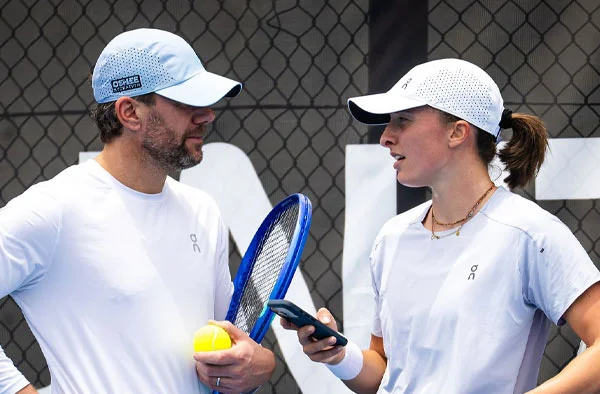
Iga Swiatek has ended her partnership with coach Wim Fissette, eighteen months after hiring him to rebuild her game following the most turbulent period of her career.
The announcement came on Monday via Instagram, a few days after Swiatek lost in the second round of the Miami Open to Polish compatriot Magda Linette — a result that would have been unthinkable twelve months ago. Swiatek confirmed the rest of her team remains unchanged. Only Fissette is leaving.
The split is being framed as a sporting decision. It is also a commercial one.
The Context
Swiatek hired Fissette in October 2024, ending a three-year partnership with Tomasz Wiktorowski. The timing was significant — she was coming off a doping ban, a ranking slide from dominant world number one to a player whose aura of invincibility had been punctured. Fissette was brought in as a stabiliser, a coach with a track record of working with elite women’s players in transition.
By any objective measure, the partnership worked. In 2025 Swiatek won three titles including Wimbledon — her sixth Grand Slam — and a Masters 1000 in Cincinnati. She finished the year ranked inside the top three. The coaching relationship delivered what it was contracted to deliver.
But elite sports partnerships are not evaluated only against what was achieved. They are evaluated against what was expected, and what comes next.
Why This Matters Commercially
Swiatek’s commercial value is directly tied to her competitive trajectory. She currently earns an estimated $13 million annually from endorsements — On Running, Rolex, Wilson, Armani, Louis Vuitton among them — which is significant but widely considered below her potential given her results. The gap between what Swiatek earns commercially and what her ranking and Grand Slam count would suggest she should earn has been a recurring topic in the industry.
The reason that gap exists is perception. Swiatek is not an easy commercial figure — reserved, intensely private, Polish, and operating in a market where Western brands still default to English-speaking athletes with larger social followings. Her doping case, however resolved, added reputational complexity. And her results in 2025, while strong, were not the era-defining dominance of 2022-2024.
A coaching change signals intent. It tells the market that Swiatek is not managing a decline — she is actively trying to get back to the top of the rankings. That narrative, if she executes on it, is commercially valuable. Brands invest in momentum, not just position.
The Fissette Question
Wim Fissette’s coaching record is one of the most interesting in women’s tennis. He has worked with Kim Clijsters, Victoria Azarenka, Angelique Kerber, Naomi Osaka, Simona Halep, and now Swiatek. In each case he has delivered results — Grand Slams, ranking improvements, technical upgrades. In each case the partnership has ended before anyone seemed fully satisfied.
There is a pattern here worth noting. Fissette is a crisis coach. He comes in when elite players are in transition or difficulty, stabilises them, and helps them win again. What he appears less suited to is the next phase — building a multi-year dominance from a position of renewed stability. The players who have worked with him tend to move on once the immediate problem is solved.
Swiatek’s immediate problem in late 2024 was confidence and consistency after her ban. That problem appears to have been resolved. Wimbledon 2025 is evidence of that. The question she is now asking — and the question the coaching change represents — is what it takes to recapture the sustained dominance that made her commercially unmatchable between 2022 and 2024.
What Comes Next
Swiatek has not announced a replacement. The clay court season begins within weeks, which is historically her strongest surface and her best opportunity to reassert herself in the rankings.
Whoever she appoints will be tasked with a specific brief: getting a player who has six Grand Slams, an immense technical foundation, and a proven mental framework back to the point where the outcome of major tournaments is not in question before they start.
That is a more interesting coaching brief than the one Fissette inherited. It will attract significant interest.
The commercial side will follow the results. If Swiatek returns to dominance on clay and wins Roland Garros in 2026, the gap between her endorsement income and her ranking will close quickly. The brands that have held off — and there are several — will move. The coaching change is the first signal that she believes that outcome is achievable.
Whether she is right is what the next six months will answer.
Tim Lee is the founder of Baseplay Tennis, based in Singapore.
